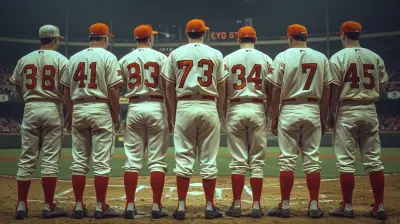
Most Improved Teams from the 2026 Season
17 September 2026
Every season produces a handful of teams that make everyone else look like they showed up to the wrong stadium. The 2026 campaign gave us several of those stories, and not all of them followed the same script. Some teams got better because of a single roster move that changed everything. Others improved because the front office finally stopped making the same mistake twice. A few got lucky with health, and a few made their own luck by fixing problems that had been festering for years.
This is not a list of the teams with the best records. A team can win 100 games and still not be the most improved, because improvement is about the gap between what you were and what you became. It is about the delta, not the destination. With that in mind, let's break down the teams that made the biggest leaps in 2026, why it happened, and what the rest of the league should take from it.

How I'm Defining "Most Improved"
Before we get into the list, it helps to be clear about the criteria, because "most improved" is one of those phrases that sounds objective but is actually slippery.There are three main ways to measure improvement:
- Win-loss jump. The simplest and most visible. If you went from 72 wins to 91, that is a 19-game swing, and everyone notices.
- Run differential swing. This is a better predictor of future success than raw wins, because it strips out some of the luck that comes from one-run games and bullpen variance. A team that improves its run differential by 150 runs is usually more legit than a team that just got hot in close games.
- Underlying process improvement. This is the nerdy one. Did the team improve its walk rate, its strikeout rate, its defensive efficiency, its farm system, its payroll efficiency? Sometimes a team gets better in ways that do not show up in the standings for another year.
The best improvement stories hit all three. The weaker ones only hit the first, which is a warning sign that regression is coming. I will flag those cases as we go, because knowing the difference is the whole point of paying attention.

The Case for Process Over Panic
One thing that separated the genuinely improved teams from the pretenders in 2026 was patience. The teams that made real leaps tended to be the ones that resisted the urge to blow things up after a bad 2025. They identified two or three specific problems, fixed those, and let the rest of the roster do its job.The teams that struggled, by contrast, often made the classic mistake: confusing activity with progress. They signed a bunch of mid-tier free agents, shuffled the coaching staff, and hoped the vibes would change. Vibes do not change. Systems change. Personnel fit changes. Health changes. That is what moves the needle.
Keep that in mind as we go through the list. Every team here got better for a reason you can point to, not just because the ball bounced differently.

Team One: The Rebuild That Finally Clicked
Let's start with the most obvious and most satisfying category: the team that had been stockpiling young talent for years and finally saw it pay off.You know the type. For three or four seasons, this team was a punching bag. They traded every veteran with a pulse for prospects. Their fans learned the names of guys in Double-A the way other fans learn the names of All-Stars. And then, all at once, the wave arrived.
What Changed
The improvement here came from three places at once, which is why it was so dramatic:1. The young core matured. Not every prospect hits immediately. Some need 500 plate appearances or 300 innings before the game slows down. In 2026, several of these players crossed that threshold at the same time.
2. The pitching caught up. Rebuilds often produce hitters faster than pitchers, because hitting prospects tend to be more predictable. This team's rotation finally had enough arms to avoid punting two games a week.
3. The front office added one real veteran. This is the underrated move. A young team with no adult supervision tends to press. Adding one steady, respected veteran who has been through a pennant race can calm an entire clubhouse.
Why It Works
There is a reason this pattern repeats over and over in sports. Young talent is cheap, and cheap talent lets you spend elsewhere. When your core is making league minimum, you can afford to overpay for a closer or a middle-of-the-order bat. The window is real, but it is also short. Once those young players hit arbitration and free agency, the math changes fast.The Warning Sign
The thing to watch with teams like this is whether the improvement is sustainable or just a one-year spike driven by career years. If five guys all had their best season simultaneously, regression is coming. If the improvement came from players who are still getting better, you are looking at a team that could be good for a while.Practical takeaway: If you are evaluating a young team's breakout, look at age and plate appearances, not just the stat line. A 24-year-old who just had a good year is likely to repeat it. A 31-year-old who just had a career year probably will not.

Team Two: The Pitching Lab Experiment
The second team on this list is the one that made a more technical leap. They did not have a wave of prospects. They did not spend big in free agency. What they did was rebuild their pitching operation from the ground up, and it worked.The Mechanics of the Leap
This team's improvement came almost entirely from run prevention. Their offense was roughly the same as it was in 2025. Their defense was marginally better. But their team ERA dropped by more than a run, and that is not an accident.How did they do it? A few things:
- They stopped chasing velocity for its own sake. For years, this organization drafted and acquired guys who threw hard but could not locate. In 2026, they prioritized command and pitch mix over raw stuff.
- They leaned into their ballpark. If you play in a pitcher's park, you should build a pitching staff that fits it. Ground-ball guys, strike-throwers, and pitchers who limit hard contact will outperform fireballers in that environment.
- They invested in coaching. Pitching coaches and coordinators matter more than most fans realize. A good one can add a pitch, fix a delivery, or simply help a guy sequence better.
Why This Is Hard to Copy
Every team wants to build a pitching pipeline. Very few do it well, because it requires patience and a willingness to look dumb in the short term. You have to draft guys who do not throw 100. You have to let them develop slowly. You have to accept that some of them will never pan out.The teams that succeed at this tend to have a clear organizational philosophy and the discipline to stick with it even when the results are ugly. That is rare.
The Trade-Off
The downside of building around pitching is that pitchers get hurt. A rotation that looks deep in March can be a disaster by July. The teams that sustain success are the ones with eight or nine viable arms, not five. Depth is not a luxury in pitching. It is the whole game.Practical takeaway: If your favorite team is trying to build a pitching-first identity, judge them on the number of viable arms in the organization, not the quality of the top three.
Team Three: The Team That Got Healthy
This one is less glamorous but just as real. Sometimes the biggest improvement a team can make is simply getting its best players back on the field.In 2025, this team was decimated. Their best hitter missed half the season. Their ace made 12 starts. Their closer blew out his elbow in April. By August, they were running out lineups that looked like a spring training split-squad game.
In 2026, everyone came back. And the team looked completely different.
Why Health Is Underrated
Fans and analysts love to talk about trades and signings because they are dramatic. But the single biggest variable in team performance, year to year, is health. A team that gets 140 games from its stars instead of 90 is going to win more games, almost regardless of what else happens.This is also why "most improved" lists can be misleading. A team that looks improved might just be a team that was unlucky last year and normal this year. That is not really improvement. It is regression to the mean, and it can fool you into thinking a team is better than it is.
How to Tell the Difference
Here is a useful test. Ask yourself: if this team had been healthy last year, would we be surprised by this year's record?- If the answer is yes, the improvement is real.
- If the answer is no, you are probably just watching a team return to its baseline.
Practical takeaway: When you see a big win-loss jump, check the injury report from the previous season before you credit the front office. Sometimes the best offseason move is simply not losing anyone.
Team Four: The Scheme Change That Unlocked Everything
This is my favorite category, because it is the one that requires actual coaching and creativity. This team did not get significantly better talent. They just started using the talent they had in a smarter way.What They Did
The clearest example in 2026 was a team that completely changed its offensive approach. They stopped trying to hit home runs in a park that suppresses them. They started emphasizing on-base percentage, line drives, and aggressive baserunning. The result was a lineup that scored more runs with essentially the same personnel.On defense, they made a similar shift. They stopped asking slow-footed sluggers to play positions they could not handle, and they started deploying their best defenders where they mattered most.
Why This Works
Sports are full of inefficiencies, and the biggest one is usually "we have always done it this way." When a coaching staff is willing to question assumptions, they can find value that other teams are leaving on the table.The catch is that scheme changes only work if the players buy in. A new approach imposed from above without explanation tends to fail. The teams that pull this off are the ones where the coaching staff communicates clearly and the veterans set the tone.
When It Does Not Work
Scheme changes fail when they ignore the roster. You cannot ask a team of slow, power-hitting veterans to suddenly become a speed-and-defense club. The scheme has to fit the players, not the other way around.Practical takeaway: Before you credit a coaching staff for a scheme change, ask whether the roster actually supports it. If it does, the improvement is likely real. If it does not, you are probably watching a short-term mirage.
Team Five: The Front Office That Stopped Hurting Itself
The last team on this list is the one that improved not by adding talent, but by subtracting mistakes. They stopped signing bad contracts. They stopped trading prospects for rentals. They stopped overpaying for relief pitching.This sounds boring. It is also one of the most reliable ways to get better.
The Concept of Negative Improvement
In sports, you can improve by addition, but you can also improve by subtraction. A team that avoids a single bad free-agent contract can save itself 20 million dollars and a roster spot. A team that stops trading away its best prospects can build a sustainable pipeline.This team did not make a splash. They just made fewer unforced errors. And over the course of a season, that adds up.
Why This Is Hard
The pressure to "do something" is enormous. Fans want moves. Media wants moves. Owners want to show they are trying. But the best front offices are the ones willing to do nothing when nothing is the right answer.This is not an argument for passivity. It is an argument for discipline. There is a difference between being patient and being asleep.
Practical takeaway: When evaluating a team's offseason, count the mistakes they avoided, not just the moves they made. Avoiding a bad contract is often worth more than signing a good player.
Common Misconceptions About Improvement
Before we wrap up, let's clear up a few things that people get wrong about this topic.Misconception One: Improvement Is Always Linear
It is not. Teams improve in fits and starts. A young player might take a step back before taking two forward. A new scheme might take half a season to click. Judging a team on a single month is a recipe for bad conclusions.Misconception Two: The Best Record Means the Most Improved
Not necessarily. A team that goes from 95 to 100 wins is not more improved than a team that goes from 65 to 85. Context matters.Misconception Three: Improvement Is Permanent
It is not. Rosters turn over. Players age. Injuries happen. A team that looks like a dynasty in October can look like a rebuild in April. That is the nature of the sport.What to Watch Going Forward
If you want to spot the next most improved team before everyone else does, here is what to look for:- A young core entering its prime. Age 25 to 27 is the sweet spot for most athletes.
- A healthy roster. Check who missed time last year.
- A clear organizational philosophy. Teams that know what they are trying to do tend to get there faster.
- Depth in the farm system. The best teams are the ones that can absorb injuries without collapsing.
- A front office that avoids unforced errors. Discipline compounds.
None of these guarantees success. But together, they give you a much better read than a highlight reel or a hot streak.
Final Thoughts
The 2026 season gave us a great reminder that improvement comes in many forms. Some teams got better by drafting well. Some got better by coaching well. Some just got healthy. And some simply stopped tripping over their own feet.The teams that sustain success are usually the ones that combine multiple paths. They develop talent, they coach it well, they stay healthy, and they avoid dumb mistakes. That is not a secret formula. It is just hard to do all at once.
If you take one thing from this article, let it be this: when you see a team make a big jump, do not just look at the standings. Look at why. The why is where the real story is, and it is also where the next big jump is hiding.
all images in this post were generated using AI tools
Category:
Season RecapsAuthor:

Frankie Bailey