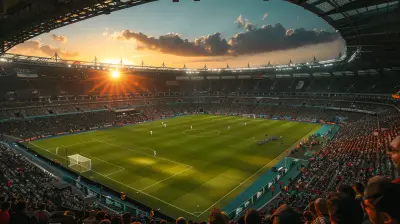
Should the Olympics Have a Permanent Home? The Political Debate
26 November 2026
Every four years, the world watches a city transform itself for the Olympic Games. Stadiums rise from empty lots, transit lines extend into new neighborhoods, and for seventeen days a metropolis becomes the center of the global conversation. Then the flame goes out, the cameras leave, and the bill arrives. That bill, and the political fight over who should pay it, sits at the heart of one of the most consequential debates in international sport: should the Olympics have a permanent home?
The question sounds simple. It is not. A permanent host would reshape the economics of the Games, the politics of the Olympic movement, and the meaning of an event built on the idea that the whole world takes turns. This article breaks down the real arguments on every side, the trade-offs that rarely make headlines, and what a sensible reform path might look like.

The Case for a Permanent Home
Supporters of a fixed host make a straightforward argument: the current model forces cities to spend enormous sums on infrastructure they may never use again, and the political fallout from those costs is now threatening the Games themselves.Cost control and infrastructure reuse
The most persuasive argument for a permanent home is financial. When a city builds an Olympic stadium, aquatics center, velodrome, and athletes' village from scratch, most of that investment is single-use. A permanent host flips the math. Facilities get used repeatedly, maintenance costs are spread across decades, and the host does not need to rebuild basic infrastructure every cycle.Consider how this works in practice. A permanent site could be chosen for existing strengths: reliable transport, available land, a climate that suits outdoor events. Over time, the venue portfolio could be upgraded incrementally rather than rebuilt wholesale. That is how major sports leagues operate, and it is how the International Olympic Committee could operate if it chose to.
Predictability for athletes and organizers
Athletes train for years around a single competition. A permanent host gives them a fixed target: the same time zone, the same altitude, the same facilities, the same conditions every cycle. Sports scientists could study the venue in depth and prepare athletes accordingly. Organizers would build institutional knowledge that currently evaporates after every Games.This is not a trivial benefit. The logistics of an Olympics are staggeringly complex, and much of the expertise developed by one organizing committee is lost when the next city starts from zero. A permanent host would accumulate that knowledge the way Wimbledon or the Super Bowl host cities do.
Ending the bidding circus
The current bid process has become a political liability. Cities spend millions just to compete for the right to spend billions. Referendums in several cities have rejected Olympic bids outright, and public trust in the process has eroded. A permanent host removes the auction entirely, which eliminates a major source of corruption risk and wasted public money.
The Case Against a Permanent Home
Opponents argue that a fixed host would solve some problems while creating others that are just as serious. Their case deserves equal weight.The universality problem
The Olympic Charter is built on the idea that the Games belong to the whole world, not to one place. Rotating the host spreads the event across continents and cultures. A permanent host would concentrate the benefits, the attention, and the economic upside in a single country for generations. That undermines the movement's core claim to universality and risks turning the Games into a regional event with global branding.Political capture and leverage
A permanent host would hold enormous leverage over the IOC. Imagine a host government that disagrees with an IOC decision, or a host country whose politics shift in ways the Olympic movement finds uncomfortable. The IOC would face pressure it currently avoids by having alternatives. Hosting rights are a form of diplomatic capital, and concentrating them permanently in one place hands a single government a permanent seat at the table.There is also the question of neutrality. The Olympics have struggled with boycotts and political interference throughout their history. A permanent host makes the Games more vulnerable to the domestic politics of one country, not less.
Economic concentration
The current model, for all its waste, distributes spending across the globe. Construction jobs, tourism revenue, and media attention rotate. A permanent host would capture that value permanently, which raises fairness questions for developing economies that see the Games as a rare opportunity for global visibility.
What History Actually Teaches
The debate often turns on claims about past hosts, so it is worth being precise about what the historical record shows.The 1976 Montreal Games are the standard cautionary tale. The city incurred enormous debt on its Olympic stadium, and the final payments were not completed until decades later. Montreal's experience became a reference point for every cost-overrun argument since.
Los Angeles in 1984 is the counterexample. The city used existing venues extensively, kept costs down, and the Games generated a surplus. That model, built on reuse rather than construction, is the strongest argument that the current system can work when hosts are disciplined.
More recent hosts have tried to split the difference. Paris 2024 leaned heavily on existing landmarks and temporary venues. London 2012 invested in a regeneration plan for a neglected part of the city, though the long-term returns remain debated. The pattern is clear: outcomes depend far more on host discipline and planning than on the rotation model itself.
What history does not support is the claim that a permanent host would automatically be cheaper. A fixed site still needs maintenance, security, and periodic upgrades. The savings come from avoiding duplication, not from avoiding cost altogether.

The Real Trade-Offs Nobody Talks About
Most commentary frames this as a binary: permanent host versus rotating host. The more useful framing is a set of trade-offs.Capital costs versus operating costs. A permanent host minimizes repeated capital spending but concentrates operating costs in one place. A rotating host spreads capital spending but repeats it. Neither model eliminates expense. The question is who bears it and when.
Predictability versus adaptability. A fixed venue is predictable, but cities change and sports evolve. New events get added, climates shift, and security requirements change. A permanent host must be designed for adaptability or it becomes obsolete.
Global reach versus institutional stability. Rotation spreads the brand but weakens institutional memory. Permanence builds expertise but narrows the audience and the political base.
Transparency versus leverage. A permanent host removes the opaque bidding process, but it also removes the competitive pressure that keeps the IOC accountable to multiple governments.
Common Mistakes in This Debate
Several arguments recur in public discussion that do not hold up well under scrutiny.Mistake one: assuming a permanent host means no construction. It does not. Venues age, standards change, and new sports demand new facilities. A permanent host would still build, just less often and more strategically.
Mistake two: treating the IOC as a neutral referee. The IOC is a political actor with its own interests. Any reform proposal must account for the incentives of the institution that would have to approve it.
Mistake three: ignoring the role of national politics. Host cities do not bid in a vacuum. National governments use the Games for prestige and domestic messaging. A permanent host would change that dynamic, not remove it.
Mistake four: assuming cost overruns are inevitable. Los Angeles 1984 and parts of Paris 2024 show that disciplined reuse can control costs. The problem is not the model alone; it is the incentives that push hosts toward spectacle.
What a Workable Middle Path Might Look Like
The most realistic reform is not a single permanent host but a hybrid system. Several options deserve serious consideration.A rotating shortlist of proven hosts
Instead of an open global auction, the IOC could maintain a small roster of cities with existing infrastructure and demonstrated competence. Hosts would rotate among them, with new cities added only after meeting strict readiness criteria. This preserves rotation and universality while cutting the waste of building from scratch.A permanent technical hub with rotating competition sites
Some functions do not need to move. Broadcasting infrastructure, medical facilities, and anti-doping laboratories could be centralized. Competition venues could rotate. This splits the difference between permanence and rotation and captures the efficiency gains where they matter most.Regional co-hosting as the default
The 2026 Winter Games, spread across Milan and Cortina in Italy, show that multi-city hosting is viable. Regional clusters could share the burden and the benefit, reducing the pressure on any single city to overbuild.Strict cost caps and reuse mandates
The simplest reform may be the most effective. Require hosts to use existing venues wherever possible, cap public spending, and publish full cost data. If the IOC enforced these rules consistently, the case for a permanent host would weaken considerably.Practical Advice for Decision-Makers
If you are a policymaker, bid committee member, or sports administrator weighing this question, a few principles are worth keeping in mind.First, separate the question of hosting model from the question of host selection. A bad host can ruin a good model, and a good host can rescue a flawed one. Fix selection before changing the structure.
Second, model the full lifecycle, not just the Games. The relevant costs include construction, operation, maintenance, and eventual decommissioning. Most bid documents stop at the closing ceremony, which is precisely where the problems begin.
Third, treat public consent as a hard constraint, not a public relations problem. Referendums have killed bids for good reasons. A model that requires public trust must earn it with transparent numbers.
Fourth, ask what the host gains after the flame goes out. The strongest hosts are those with a regeneration plan that stands on its own merits, independent of the Games.
The Bottom Line
A permanent Olympic home is not a crazy idea, but it is not a simple fix either. It would reduce waste and build institutional expertise, and it would also concentrate power, narrow the movement's global reach, and create new political vulnerabilities. The current rotating model is wasteful and increasingly unpopular, but it distributes benefits and preserves the universality the Games depend on.The most defensible position is neither extreme. Reform the bidding process, mandate reuse, cap costs, and build a rotating roster of proven hosts. That approach keeps what works about rotation while fixing what does not. The debate over a permanent home is valuable precisely because it forces the Olympic movement to confront a question it has avoided for decades: who are the Games actually for, and who should pay for them?
all images in this post were generated using AI tools
Category:
Sports And PoliticsAuthor:

Frankie Bailey